Technology & Methods
Scientific Rigour.
Computational Power.
TechSim was founded on the principle that the most powerful computational tools should be accessible to industry and science alike. Our work bridges theoretical mathematics, physics and modern AI.
Our Mission
Turning complex real-world problems into tractable models
TechSim develops and applies models, methods and tools for numerical simulation and optimisation, addressing problems from empirical science, engineering and industrial process design. A particular focus lies on models for the optimal design of complex industrial processes.
At the core of our work are numerical methods for partial differential equations, including robust, parallel and adaptive multigrid solvers. These advanced approaches allow us to solve large-scale problems that are beyond the reach of standard methods.
Where it adds value, we complement our simulation expertise with data-driven approaches and AI, for example in the context of software development or the analysis of simulation results.
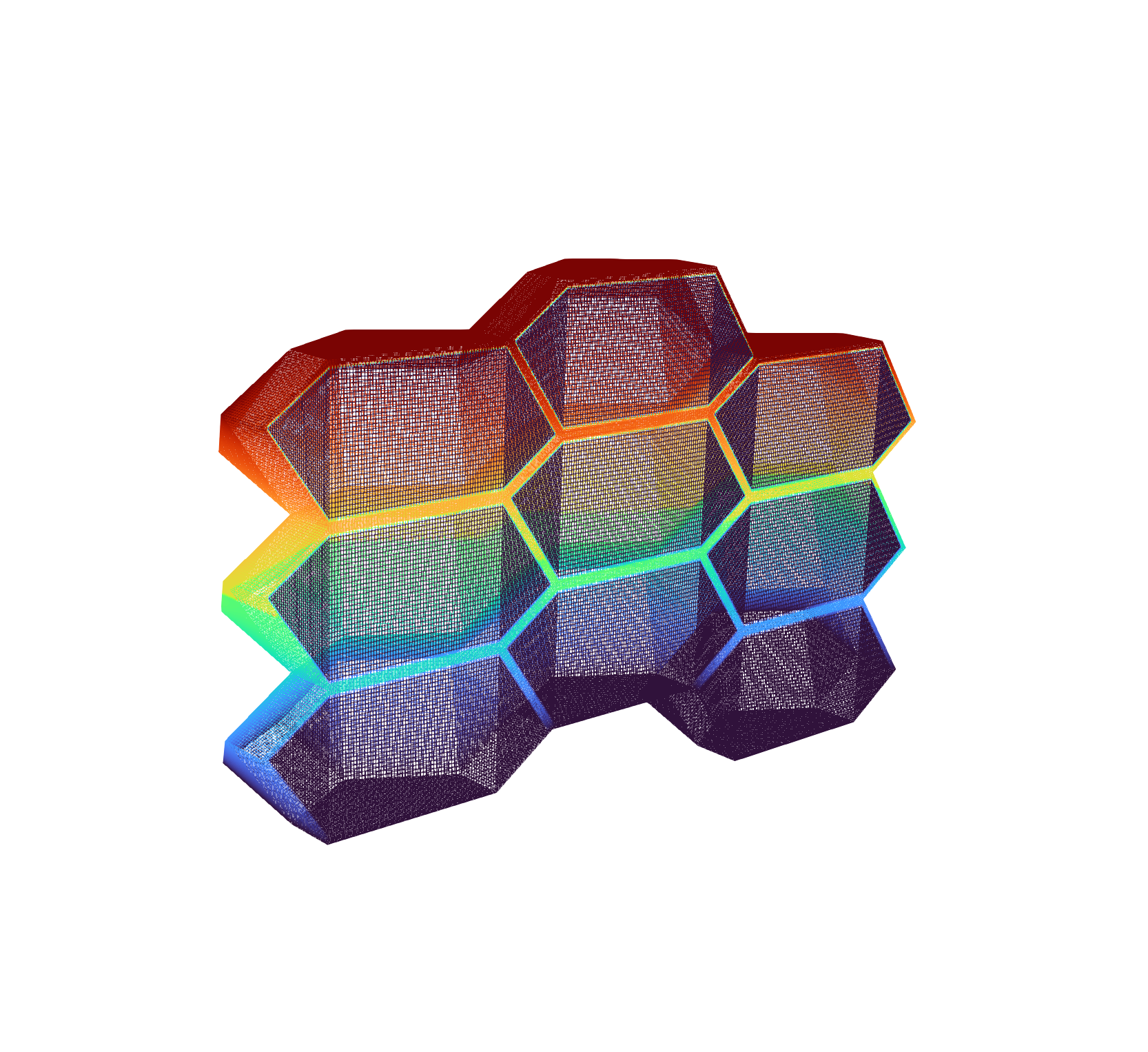
Steady-state solution for pharmaceutical substance extracellular space (S. Granulosum).
Simulation created with UG4.
Methodology
Our Approach
Every engagement follows a systematic methodology that ensures scientific validity, computational efficiency and industrial applicability.
Physical Modelling
We start with first-principles physical models derived from governing equations: conservation laws, transport equations, reaction kinetics and field theories.
Numerical Discretisation
Complex models are translated into computationally tractable discrete systems using finite element, finite volume and finite difference methods on adaptive meshes.
Robust Solvers
We implement and apply highly advanced multigrid solvers that are parallel, adaptive and robust, enabling efficient solution of large-scale, ill-conditioned systems.
AI Enhancement
Physics-based models are combined with machine learning to capture residual complexity, accelerate simulation through surrogate modelling and enable data-driven optimisation.
Optimisation
Industrial processes are designed and controlled via model-based optimisation, covering parameter identification, optimal control and design space exploration.
Validation & Uncertainty
All models are validated against experimental data. Uncertainty quantification provides confidence intervals and sensitivity analyses.
Core Expertise
Advanced Numerical Methods
Multigrid Methods
Robust solvers for elliptic and parabolic PDEs. Optimal O(N) complexity, parallel-ready for large-scale problems.
Adaptive Mesh Refinement
Error-driven local refinement concentrates computational effort where it matters most.
Finite Element Methods
Galerkin and mixed FEM for complex geometries, supporting hp-adaptivity.
Large-Eddy Simulation
High-fidelity turbulence modelling resolving large eddies directly on fine computational grids.
Monte Carlo & QMC
Stochastic simulation for high-dimensional problems in finance, UQ and computational biology.
Physics-Informed ML
Neural networks constrained by governing equations, making them interpretable, data-efficient and physically consistent.
Built on UG4
The numerical methods described above are implemented in UG4, an open-source simulation framework initiated by Prof. Gabriel Wittum.
The methods, models and results described on this page reflect the work of TechSim and its collaborators over many years. Individual contributions are gratefully acknowledged.